In April 1665, Richard Sainsbury, a carpenter of London, made his last will and testament.1 In it, he bequeathed several leasehold properties in Southwark, Surrey, to his wife Rebecca for the duration of her life. He specified that upon her death, the lease of his residence and an adjoining tenement on the east side were to pass to his granddaughter, Rebecca Leeson. However, this gift came with a condition: Rebecca Leeson was to release her brother, John Leeson, from a legacy bequeathed to her by their father, Henry Leeson, totaling more than £30.
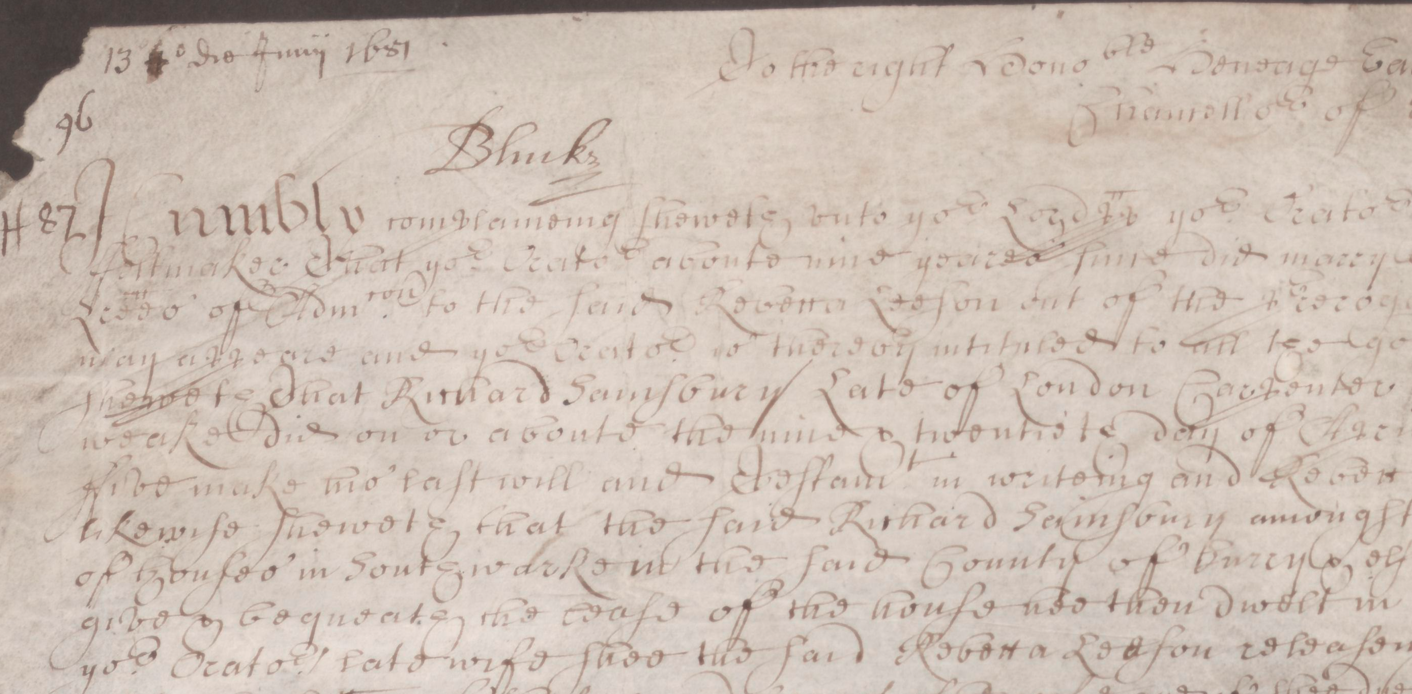
Richard Sainsbury died shortly after making his will, which did not name an executor. His wife, therefore, obtained letters of administration for his personal estate, giving her control over his assets. She then surrendered the leases originally held in Richard’s name to their ground landlord, Edward Potkin, and secured new leases in her own name, maintaining the same terms. Although she was only allowed to use the properties during her lifetime, in 1667 she rented part of the property to a man named Richard Jeffes for sixteen years—which was the amount of time left in the lease that Richard Sainsbury had originally signed.
In about 1675 (although no record has been found), Rebecca Sainsbury’s granddaughter Rebecca Leeson married John Tomlinson, a feltmaker from Southwark. About three years later, in 1678, her grandmother, Rebecca Sainsbury, died. Before her death, she made a will and appointed her son-in-law John Spicer as executor.2 Spicer took control of her possessions, including the leases. (Incidentally, Rebecca Sainsbury’s will included a bequest to her niece, Elizabeth Griffin, “now inhabiting in Virginia.” Mentioned here because wills of this period rarely name English emigrants to the American colonies.)
Initially, Spicer allowed his step-daughter Rebecca and his son-in-law John Tomlinson to take possession of and collect rents from the property that was bequeathed to Rebecca (Leeson) Tomlinson by her grandfather Sainsbury—and which her grandmother Sainsbury had then leased to Richard Jeffes. But after Rebecca’s untimely death in early 1681, Spicer became hostile. He was likely angry, in part, because he “had mainteined the said Rebecca the comp[lainan]ts wife whilest she was seke for many yeares. . . .”3 Spicer threatened to dispossess Tomlinson of the property in question and sued Richard Jeffes, Tomlinson’s tenant, for unpaid rent and breach of lease covenants. John Tomlinson responded by filing a complaint in the Court of Chancery in June 1681, asserting his late wife’s entitlement to the lease under her grandfather’s will, and accusing his late wife’s step-father John Spicer and his brother-in-law John Leeson of unjust behaviour. (Ref. C 8/304/47; digital images acquired by author.)
Spicer and Leeson responded in July 1681, acknowledging the will of Richard Sainsbury and the lease to Richard Jeffes but insisting that Rebecca (Leeson) Tomlinson had failed to meet the condition attached to her inheritance: she had not released her claim to the full legacy from her father. In fact, Tomlinson and his wife had sued John Leeson in the Court of Exchequer in 1678–soon after Rebecca Sainsbury’s death—for the full sum of £200. Eventually, they reached a settlement for £60, which Spicer and Leeson claimed nullified her right to the leasehold estate.
Additionally, John Leeson admitted to having some of the late Rebecca (Leeson) Tomlinson’s belongings, including a silver tankard and linens, valued at £7 9s. However, he asserted a legal right to them, having had them condemned in the Sheriff’s Court of London to satisfy a debt Tomlinson owed him.
Thus, by mid-1681, the matter stood unresolved: Tomlinson claimed the leasehold estate by right of his late wife, while Spicer and Leeson contested this on the grounds that she had forfeited her inheritance by claiming her full legacy from her father. Meanwhile the tenant, Richard Jeffes, faced possible eviction, financial loss, and legal confusion, all because of a tangled inheritance dispute and uncertainty over who actually had the right to lease the property in a conflict that spanned three generations.
Note: The first draft of this post was generated by ChatGPT from transcripts prepared by the author. It was subsequently edited by the author for accuracy. The title of this post was likewise generated by ChatGPT; it was one of several selected by the author.
- National Archives (UK), ref. PROB 11/316/554; indexed as Will of Richard Samsbury [sic], Carpenter of Saint Olave Southwark, Surrey. Assuming he was between 50 and 60 years old, Richard may have been the Richard Sainsbury baptised in Trowbridge, Wiltshire in 1611, son of George. There are no other indexed Richard Sainsburys or variant surname baptised in England in the 20-year period between 1600 and 1620. (Ancestry.co.uk search of births: ric* sainsbury “exact” “sounds like” or “similar.”) ↩︎
- National Archives (UK), ref. PROB 11/359/13; indexed as Will of Rebecca Saintbury, Widow of Saint Olave Southwark, Surrey. ↩︎
- National Archives (UK), ref. C 8/304/47, Tomlinson v Spicer, 1681, folio 2. ↩︎