Are You Canadian?

If you can prove your descent from an ancestor born in what is now Canada … the answer might be “Yes”!

Canada’s first Citizenship Act came into effect on January 1, 1947. Anyone born in Canada before that date was considered a “natural-born Canadian” as long as they had not lost their status as a British subject prior to that date:

  1. A person, born before the commencement of this Act, is a natural-born Canadian citizen:–
    (a) if he was born in Canada … and has not become an alien at the commencement of this Act.

Posthumous application?

This applied to anyone born in Canada before January 1, 1947. But did it also apply to those who were born in what is now Canada, but who had died before that date?

Section 3(1.5) of the current Citizenship Act provides for the transmission of citizenship from some deceased citizens to children born outside Canada. But only those whose parent or grandparent has died:

(1.5) A person who would not become a citizen under one of the paragraphs of subsection (1) for the sole reason that their parent or both their parent and their parent’s parent died before the coming into force of An Act to amend the Citizenship Act (2025) is a citizen under that paragraph if that parent — or both that parent and that parent’s parent — but for their death, would have been a citizen as a result of the coming into force of that Act.

Despite this paragraph in the current Act, if the 1947 Act applied to those who were born in what is now Canada, but who had died before January 1, 1947, it included Acadians born on the peninsula of what is now Nova Scotia; they became British subjects after the Treaty of Utrecht in 1713. It also included anyone born in the northern part of New France (then called Canada), and the island of Newfoundland, which came under British rule after the Treaty of Paris in 1763.

All those people were born in what is now Canada “before the commencement of this Act.” As long as they did not lose their status as British subjects, did each become a “natural-born Canadian citizen” on January 1, 1947?

“A map of Canada and the North part of Louisiana with the adjacent countrys. By Thos. Jefferys, Geographer to his Majesty,” 1762, published by Thos. Jefferys near Charing Cross London. T. Jefferys sculp. [cartographic material]; accessed as Library and Archives Canada (https://central.bac-lac.gc.ca/.redirect?app=fonandcol&id=4148997&lang=eng&ecopy=n0013264k). This copy may only be used for research and private study.

More importantly, if everyone born in what is now Canada before January 1, 1947 became citizens under Section 4(a) of the first Citizenship Act, their children born outside Canada up to January 1, 1947 also became Canadian citizens under Section 4(b) (and subsequent amendments that removed discriminatory circumstances):

A person, born before the commencement of this Act, is a natural-born Canadian citizen:–
(b) if he was born outside of Canada … and his father [read: parent] … was born in Canada

This Act created a first-generation limit on the transmission of Canadian citizenship for those born outside Canada.

First Generation Limit

This first generation limit was partly amended by the 1977 Citizenship Act. Under that Act, a child born outside Canada to a Canadian parent was Canadian. But only if the child was born after February 15, 1977:

3. (1) Subject to this Act, a person is a citizen if
(b) he was born outside Canada after the coming into force of this Act and at the time of his birth one of his parents … was a citizen

Thirty years later, in 2009, Bill C-37 amended the Citizenship Act by adding Sections 3(3), paragraphs (a) and 3(b) to prevent the children of Canadian citizens who were themselves born outside Canada from becoming citizens at birth — thus enshrining a First Generation Limit.

Bill C-3 An Act to amend the Citizenship Act

In 2023, Justice Akbarali found the First Generation Limit in the Citizenship Act to be unconstitutional, and therefore of “no force and effect.”

In response, the Parliament of Canada passed Bill C-3 An Act to amend the Citizenship Act (2025), which came into effect on December 15, 2025. This amendment removed the First Generation Limit of Section 3(3) and replaced it with a parental residency requirement — but only for those born outside Canada on or after December 15, 2025.

Implications

It would seem, then, that with no generational limit on the transmission of citizenship to those born outside Canada, Canadian citizenship has been passed down, in some cases, for more than 300 years from distant ancestors who became “natural-born Canadian citizens” by virtue of the 1947 Act to all descendants born outside what is now Canada.

This interpretation seems confirmed by publicly available reports of applicants receiving their certificates of Canadian citizenship based on “Gen 0” ancestors born in Acadia in 1730 and Quebec in 1806.

Present-day descendants

Today, Canadian citizenship by descent presumably applies to anyone 49 years or older (i.e., born before February 15, 1977) who was born outside Canada to a Canadian parent, as stated in Section 3(1)(d) of the Citizenship Act:

Subject to this Act, a person is a citizen if
(d) the person was a citizen immediately before February 15, 1977.

By extension, children of those who were citizens before February 15, 1977, and who were born outside Canada, would be citizens under Section 3(1)(b) of the Citizenship Act:

Subject to this Act, a person is a citizen if
(b) the person was born outside Canada after February 14, 1977 and at the time of his birth one of his parents, other than a parent who adopted him, was a citizen.

The only limit might be the dates on which various parts of Canada came under British rule.

The next step — for anyone wanting to confirm their Canadian citizenship — is to apply to Immigration, Refugees and Citizenship Canada for a certificate of Canadian citizenship. (There’s also a process for those who want to renounce their “new” citizenship.)


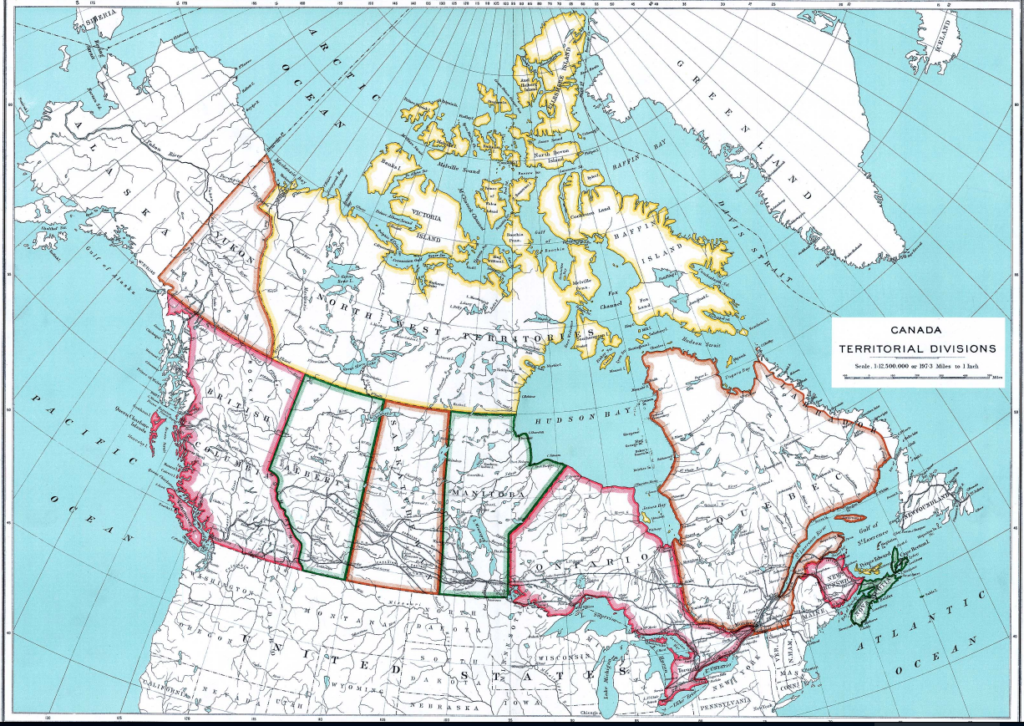
Canada, Department of the Interior, Atlas of Canada, revised and enlarged ed. (1915), map 3-4 “Territorial Divisions”; accessed as https://atlas.gc.ca/PDF/1915_Atlas_E.pdf

I’ve helped many clients find the documents they need to apply for certificates of Canadian citizenship. I can help you, too! Contact me for more information.

Disclaimer: I am a genealogist, not a lawyer. This post does not constitute legal advice or opinion. It contains my personal observations to provide a non-expert interpretation of Canada’s current law regarding citizenship by descent.

British Birth, German Ancestry, Canadian Father

DNA Identifies the Father of an English-born Child

Growing up in London, England, Elaine’s biological father was a mystery. Her mother said he had been a Canadian airman stationed in Europe in the late 1950s. Beyond that, there were no names, no records, no photographs — just a story, repeated but never explained.

For decades, Elaine wondered who her father was. In time, genetic genealogy would lead to the answer.


Following the DNA Clues

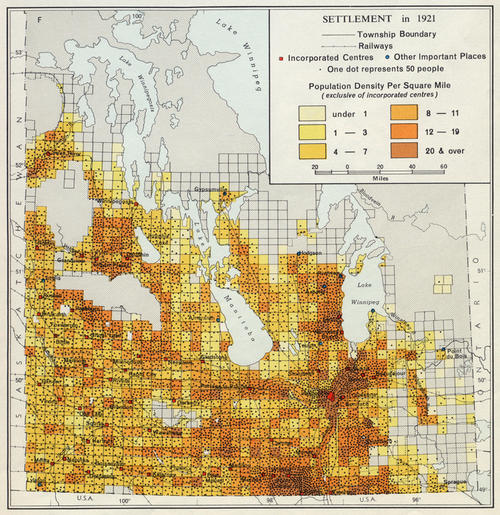
When Elaine first looked through her DNA results, she noticed something interesting and quite surprising: many of her closest paternal matches were from Western Canada, particularly from families with roots in German immigrant farming communities that had settled in southern Manitoba and Saskatchewan.

Two names began appearing again and again among her matches’ family trees:
Schmidt and Dawson.

One group of matches traced back to a Schmidt family who had lived on the Canadian Prairies for generations. Another cluster of matches traced back to a Dawson family in the same area.

Province of Manitoba, Settlement in 1921. University of Manitoba Libraries. http://hdl.handle.net/10719/2694617

These findings prompted further research to identify a “union couple” — perhaps a marriage between a member of the Schmidt and Dawson families — because descendants of that couple would have inherited the same DNA pattern found in Elaine’s results. In other words . . .

Elaine’s father was probably the son of a Schmidt parent on one side, and a Dawson parent on the other.

Additional evidence indicated the Schmidt parent was likely Elaine’s grandfather. Further research showed there was only one son born to a Schmidt father and a Dawson mother in the right time period, and in the right place. That son would later serve in the Canadian military in the 1950s.


A Brief Marriage, a Young Son, a Difficult Loss

In the early years of the 20th century, Ernst Schmidt — a young farmer — married Lillian Dawson, the daughter of a nearby homesteading family.

Their marriage was heartbreakingly short. Lillian died just two years later, likely due to complications following childbirth. She left behind two small children — a baby boy named Peter and an infant daughter.

Peter grew up in rural Manitoba and enlisted in the Canadian military as a young man.

Publicly available military records showed his unit was posted to Germany in 1957. But whether he was ever in London around that time remained a mystery.


DNA Confirmation Strengthened the Case

To test the theory that Peter Schmidt was Elaine’s biological father, dfh DNA Family Help compared the amount of DNA Elaine shared with matches on both sides of Peter’s family — Schmidt relatives and Dawson relatives.

The numbers aligned perfectly with what would be expected if Peter Schmidt were Elaine’s biological father.

Every piece of evidence — DNA clusters, shared matches, family connections, timelines, and geographic movement — pointed to the same conclusion:

Elaine’s father was almost certainly Peter Schmidt, a Canadian soldier born in Manitoba in the 1930s.

Peter passed away in the late 1990s, but traces of his life remain — including a gravestone in Western Canada that includes the insignia of his military regiment, and his military personnel file, which remained in the archives of the Department of Defense. After the genetic investigation concluded, Peter’s niece obtained a copy of that file, which proved Peter was in London the year before Elaine’s birth.


A Life Reconnected

For Elaine, the discovery was deeply meaningful. Her ancestry wasn’t the story of a brief romance during the Cold War that faded into silence.

It was the story of Canadian prairie farms, immigrant grit, young love, loss, and a branch of family never knew she existed — until DNA helped bring the pieces back together.


Canadian Citizenship by Descent

Elaine’s discovery made her eligible to apply for a certificate of Canadian citizenship. That’s because “In 2009, you became a Canadian citizen if you: were born outside Canada in the first generation to a Canadian parent on or after January 1, 1947, and you lost or never had citizenship due to former citizenship provisions.” (Source: https://www.canada.ca/en/immigration-refugees-citizenship/services/canadian-citizenship/act-changes/rules-2009-2015.html)

Recent changes to the Citizenship Act removed that first generation limit.

Because her father was in the Canadian Armed Forces at the time of her birth, Elaine could also pass her citizenship to her UK-born children. That restriction (that a person in the second generation born outside Canada was a Canadian citizen only if their grandparent was in the Canadian Armed Forces, or the federal public administration, or the public service of a province or territory at the time of their parent’s birth) changed on December 15, 2025, when Bill C-3 amended the Citizenship Act to remove the “First Generation Limit.” Now, according to an email received from the office of the Minister of Immigration, Refugees and Citizenship Canada, the law is simply this:

To be eligible for Canadian citizenship by descent, a person born abroad before December 15, 2025 must have an ancestor who became a Canadian citizen on or after January 1, 1947 (or on or after April 1, 1949, in Newfoundland). This includes those whose ancestor became a citizen through the 2009, 2015, or 2025 amendments to the Citizenship Act.

In Elaine’s case, she not only identified her biological father, she and her children also became Canadian citizens. All thanks to the power of DNA!

All names in this post have been altered for privacy.

A Montreal Mystery: How DNA Helped Reveal a Hidden Finnish Heritage

When Marjorie set out to learn more about her family history, she thought she already knew who her grandfather was. Her mother’s birth certificate, baptism record, and even the 1931 Canadian census all pointed to the same man: Harold Benson, an electrician living in Montreal. Although Harold was not married to Marjorie’s maternal grandmother, he was consistently listed as the father of her child.

But something about the story didn’t quite add up.

For one, Harold was listed as being born in England, the son of English parents. Yet Marjorie’s DNA results showed a strong connection to Finland—about 30% of her ancestry. That was far too much to ignore. Could it be that her family’s story had been misunderstood—or perhaps deliberately altered—nearly a century ago?


The Trail Begins in Montreal, 1931

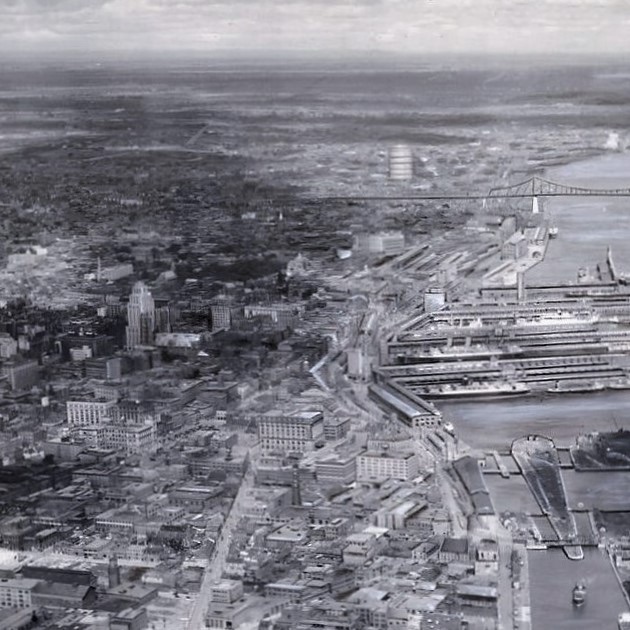
Aerial view of downtown Montreal in 1931.

The census of 1931 shows Harold Benson living with Marjorie’s grandmother, Clara Whitfield, and their infant daughter, Irene (Marjorie’s mother). He was an electrician in the paper mill industry. Family stories suggested he died in a tragic mining accident not long after Irene was born, but searches of accident records turned up nothing.

Meanwhile, just a few blocks away, another man appeared in the same census: a Finnish immigrant named Harold Simonson who was also an electrician. He lived in a small apartment with a roommate—Carl Niemi, a fellow Finn.

Two men, both electricians, both named Harold, both enumerated a few blocks from each other in Montreal. Coincidence? Or was there a deeper connection?


Following the DNA

Marjorie’s closest DNA matches on her mother’s side connected her not to England, but to extended Finnish families. As the research progressed, the surname Lauhakangas consistently appeared. It linked a large cluster of Marjorie’s matches to a set of common ancestors in rural Finland in the 1800s.

The strongest theory that emerged was this: Marjorie’s true grandfather was not Harold Benson (aka Harry Simonson)—but his roommate, Carl (“Charlie”) Niemi, the Finnish electrician who shared a flat with Harry Simonson.

Carl had come to Canada from Finland in the 1920s. Records show that in 1941, a decade after Irene’s birth, he married a Finnish woman named Elsa Korhonen in Montreal. His mother’s name was listed as Tekla Lauhakangas—the same surname that appeared over and over again in Marjorie’s DNA connections.


A Finnish Legacy

If this theory were correct, then Harry Simonson’s roommate, Carl Niemi, was likely Marjorie’s biological grandfather, and her family story stretches back to Finland, not England. The DNA matches fit the puzzle: Marjorie’s connection to a distant cousin, Katherine Olson, was exactly the right amount for them to share great-great-grandparents through the Lauhakangas line.

Suddenly, the pieces make sense. The unexplained Finnish DNA. The mysterious “Harold Benson” who seemed to vanish from later records. The neighbouring Finn named Harold Simonson who may have been mistakenly—or perhaps intentionally—recorded as Irene’s birth father. And Harold’s roommate, Carl Niemi, whose genetic heritage linked him to Marjorie through her Montreal-born mother.


The Road Ahead

Like many family mysteries, this one will need a bit more work. More research into Finnish records, and DNA testing of Carl Niemi’s descendants, will likely provide the best possible evidence that Carl was Irene’s father. But for Marjorie, the story has already shifted:

Her mother’s real story wasn’t about an Englishman lost in a mining accident—it was about a Finnish immigrant who came to Montreal seeking opportunity, and whose story became entwined with hers.

And thanks to DNA, an untold history has finally been revealed.


? Stories like Marjorie’s show how DNA can uncover forgotten chapters of family history. Sometimes the truth is hiding just a few blocks away—or across the ocean.

This post is provided for illustrative purposes. Some details have been modified from the original case report. All names in this post have been changed except the Lauhakangas surname.

Leases, Legacies, and Litigation: A Chancery Case from Restoration-Era London

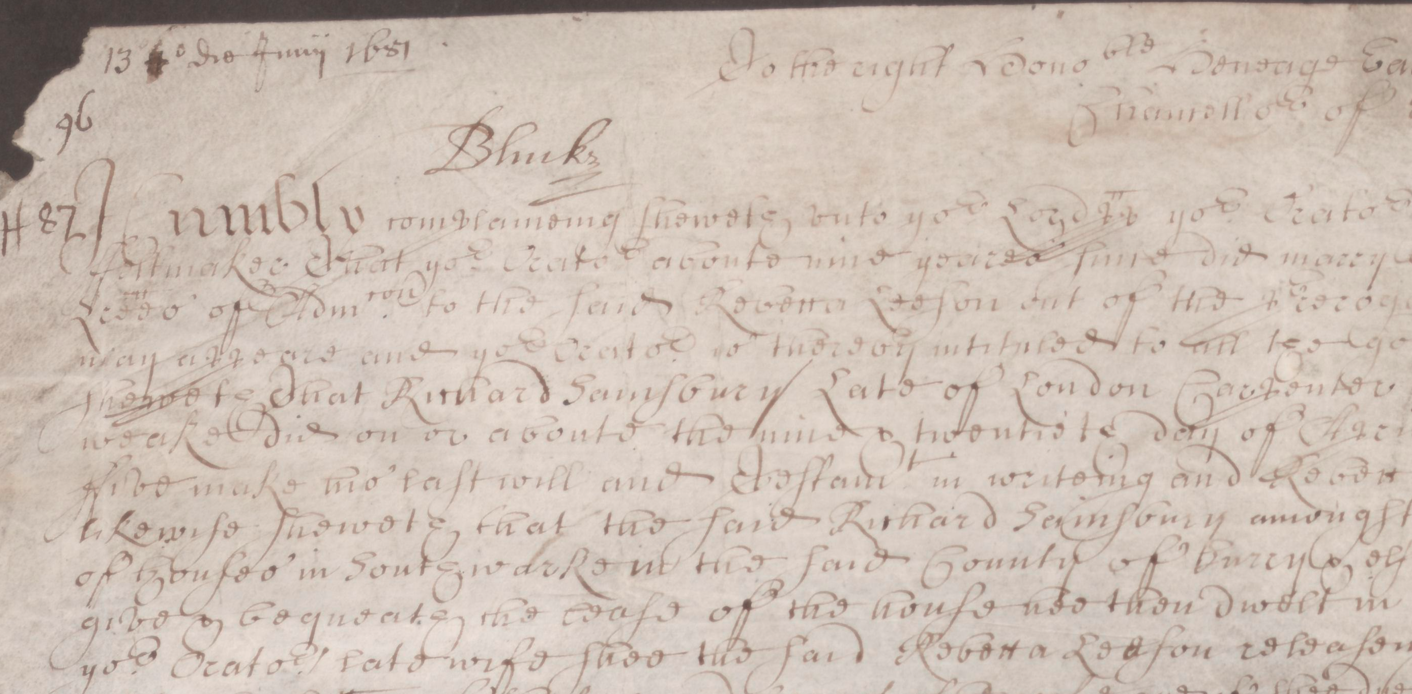
In April 1665, Richard Sainsbury, a carpenter of London, made his last will and testament.1 In it, he bequeathed several leasehold properties in Southwark, Surrey, to his wife Rebecca for the duration of her life. He specified that upon her death, the lease of his residence and an adjoining tenement on the east side were to pass to his granddaughter, Rebecca Leeson. However, this gift came with a condition: Rebecca Leeson was to release her brother, John Leeson, from a legacy bequeathed to her by their father, Henry Leeson, totaling more than £30.

Detail of the complaint of John Tomlinson,13 July 1681. The name Richard Sainsbury “Late of London Carpenter” can be seen in the fifth line of text.

Richard Sainsbury died shortly after making his will, which did not name an executor. His wife, therefore, obtained letters of administration for his personal estate, giving her control over his assets. She then surrendered the leases originally held in Richard’s name to their ground landlord, Edward Potkin, and secured new leases in her own name, maintaining the same terms. Although she was only allowed to use the properties during her lifetime, in 1667 she rented part of the property to a man named Richard Jeffes for sixteen years—which was the amount of time left in the lease that Richard Sainsbury had originally signed.

In about 1675 (although no record has been found), Rebecca Sainsbury’s granddaughter Rebecca Leeson married John Tomlinson, a feltmaker from Southwark. About three years later, in 1678, her grandmother, Rebecca Sainsbury, died. Before her death, she made a will and appointed her son-in-law John Spicer as executor.2 Spicer took control of her possessions, including the leases. (Incidentally, Rebecca Sainsbury’s will included a bequest to her niece, Elizabeth Griffin, “now inhabiting in Virginia.” Mentioned here because wills of this period rarely name English emigrants to the American colonies.)

Initially, Spicer allowed his step-daughter Rebecca and his son-in-law John Tomlinson to take possession of and collect rents from the property that was bequeathed to Rebecca (Leeson) Tomlinson by her grandfather Sainsbury—and which her grandmother Sainsbury had then leased to Richard Jeffes. But after Rebecca’s untimely death in early 1681, Spicer became hostile. He was likely angry, in part, because he “had mainteined the said Rebecca the comp[lainan]ts wife whilest she was seke for many yeares. . . .”3 Spicer threatened to dispossess Tomlinson of the property in question and sued Richard Jeffes, Tomlinson’s tenant, for unpaid rent and breach of lease covenants. John Tomlinson responded by filing a complaint in the Court of Chancery in June 1681, asserting his late wife’s entitlement to the lease under her grandfather’s will, and accusing his late wife’s step-father John Spicer and his brother-in-law John Leeson of unjust behaviour. (Ref. C 8/304/47; digital images acquired by author.)

Spicer and Leeson responded in July 1681, acknowledging the will of Richard Sainsbury and the lease to Richard Jeffes but insisting that Rebecca (Leeson) Tomlinson had failed to meet the condition attached to her inheritance: she had not released her claim to the full legacy from her father. In fact, Tomlinson and his wife had sued John Leeson in the Court of Exchequer in 1678–soon after Rebecca Sainsbury’s death—for the full sum of £200. Eventually, they reached a settlement for £60, which Spicer and Leeson claimed nullified her right to the leasehold estate.

Additionally, John Leeson admitted to having some of the late Rebecca (Leeson) Tomlinson’s belongings, including a silver tankard and linens, valued at £7 9s. However, he asserted a legal right to them, having had them condemned in the Sheriff’s Court of London to satisfy a debt Tomlinson owed him.

Thus, by mid-1681, the matter stood unresolved: Tomlinson claimed the leasehold estate by right of his late wife, while Spicer and Leeson contested this on the grounds that she had forfeited her inheritance by claiming her full legacy from her father. Meanwhile the tenant, Richard Jeffes, faced possible eviction, financial loss, and legal confusion, all because of a tangled inheritance dispute and uncertainty over who actually had the right to lease the property in a conflict that spanned three generations.

Note: The first draft of this post was generated by ChatGPT from transcripts prepared by the author. It was subsequently edited by the author for accuracy. The title of this post was likewise generated by ChatGPT; it was one of several selected by the author.

  1. National Archives (UK), ref. PROB 11/316/554; indexed as Will of Richard Samsbury [sic], Carpenter of Saint Olave Southwark, Surrey. Assuming he was between 50 and 60 years old, Richard may have been the Richard Sainsbury baptised in Trowbridge, Wiltshire in 1611, son of George. There are no other indexed Richard Sainsburys or variant surname baptised in England in the 20-year period between 1600 and 1620. (Ancestry.co.uk search of births: ric* sainsbury “exact” “sounds like” or “similar.”) ↩︎
  2. National Archives (UK), ref. PROB 11/359/13; indexed as Will of Rebecca Saintbury, Widow of Saint Olave Southwark, Surrey. ↩︎
  3. National Archives (UK), ref. C 8/304/47, Tomlinson v Spicer, 1681, folio 2. ↩︎

Breaking Down a Brick Wall: New Research Investigates the Patriline of Daniel Sansbury of Darlington County, SC

For many descendants, Daniel Sansbury (c.1740s/50s?-1816) of Darlington County, South Carolina, has been a “brick wall” ancestor. Identifying his paternal line and his immigrant ancestor has been a long-standing challenge. But recent research combining Y-DNA analysis and archival records may shed new light on Daniel Sansbury’s origins.

Full Report

The Sainsbury-Sansbury group project on FamilyTreeDNA was established, in part, to tackle this very problem. Through this project, a unique genetic pattern emerged in a set of Y-DNA test takers that connects Daniel Sansbury’s descendants to several Sainsbury families whose paternal lines trace back to Wiltshire, England.

This specific genetic pattern, currently defined as Y-DNA haplogroup R-FTA27580, strongly indicates that Daniel Sansbury’s ancestors were most likely Sainsburys who lived in Wiltshire as far back as the 1500s.

AI-Generated Podcast (Report Summary)

AI-produced outputs can include inaccuracies. Enjoy this sound file, but examine original sources.

Drawing on this genetic evidence and using historical records, the report proposes a patriline that links Daniel Sansbury to George Sainsbury of Trowbridge (c.1535-aft.1586).

Crucially, the report identifies a possible immigrant ancestor: a boy or young man named Daniel who left England in late 1678 for the Colony of Virginia. After his arrival, he worked for more than eight years as an indentured servant.

Court records from Old Rappahannock County, Virginia document his efforts to gain freedom after his eight-year term of service ended in January 1686/87. Eventually, in May, 1689, he was ordered “free from any further time of service” and by November 1699, he was married to a woman named Phebe.

If this couple had children in the late 1600s, one may have been the ancestor of Daniel Sansbury of Darlington County a generation or two later. This hypothesis, based on evidence presented in the report, marks a significant step forward in identifying—or at least hypothesizing—a paternal lineage for Daniel Sansbury of Darlington County.

You can read the full report for a detailed presentation of the evidence. Or listen to a plain-language summary in an engaging AI-generated podcast!

How I Use DNA to Identify an Unknown Ancestor

What does a genetic genealogist do? Well, after you’ve submitted your DNA to multiple databases and shared those results with me, here’s what I do — depending on your unique situation — to achieve or advance your research goal.

As you’ll see, this is a time-intensive process that requires patience and persistence! It also requires adequate DNA matches and the availability of written records.

  1. I Organize Your DNA Matches
    I group your matches using methods such as the Leeds Method. This creates clusters of cousins who are related to you — and each other — through at least one common ancestor.
  2. Distinguish Maternal and Paternal Lines
    I separate matches into maternal and paternal branches to focus on the relevant lineage that contains your unknown ancestor.

The first two steps can typically take about a day. They may be completed during a six-hour research contract. You may then decide to complete the next steps yourself, or hire me for part of the work, or arrange a face-to-face session where I can teach you how to accomplish the next steps yourself.

  1. Consider DNA Amounts and Build Family Trees for Close Matches
    At this point, I concentrate on your closest matches in the relevant group. I use the Shared cM Project to consider how much DNA they share with you and how they might be related to you. I also identify the most recent common ancestor(s) (MRCAs) that link many or all your matches in the relevant clusters. Then I may expand the tree sideways to include siblings of the MRCAs and work downward — if records are available — to the present generation. The goal here is to identify individuals who fit the time and location for the conception event.
  2. Consolidate Family Trees
    With more research, especially into marriage records, and considering geography and ethnicity, I try to link separate family trees by identifying couples whose children would have inherited DNA from at least two previously identified clusters.

Building family trees takes time. Several trees are typically built at the same time and they require a lot of records searching to ensure accuracy. Tens of hours are typically spent on these steps.

  1. Analyze Clusters and Use the WATO Tool
    After identifying a cluster of descendants from the suspected MRCA, I may use the “What Are The Odds plus” (WATO plus) tool to formulate and test hypotheses about potential parents.

This phase requires good data input and expert analysis to work through the options and consider which hypotheses are most likely.

  1. Present a Hypothesis
    If enough DNA matches are present, and the records exist to support a theory, I’ll present a hypothesis of the unknown ancestor’s identity. This will likely need to be tested with more evidence, for example: targeted DNA testing among the proposed ancestor’s nearer relatives and any information those family members may have about the proposed connection to your family.

At the end of each research session I write a formal report. This is your record of what was found in the process, and what all the information means for your research goal.

From Paper to Podcast: Transforming Client Reports Using AI Technology

As a genetic genealogist, I’m constantly looking for innovative ways to share my research findings with clients and family members. Written client reports remain the backbone of my work. But those reports include a lot of technical details to prove or disprove a case. On the other hand, AI text-to-speech technology can take those reports and make the results more accessible and engaging for my clients.

Why Convert Client Reports to Audio?

  • Accessibility: Some clients prefer listening over reading, especially those with visual impairments or reading difficulties
  • Multi-tasking: Clients can listen to the results of the research they commissioned while driving, exercising, or doing household tasks
  • Enhanced Understanding: Hearing complex genetic relationships explained can help clients better grasp family connections
  • Modern Appeal: Offering multiple formats shows technological adaptability and meets diverse client preferences.

Here are two examples that have been converted from lengthy family history documents to podcast format using Google’s NotebookLM Audio Overview tool:

19-minute podcast version of “Information back then–. There wasn’t much of it”: A Narrative Lineage of a McIntyre Family in Québec and Ontario, 1773-1910 thanks to Google’s NotebookLM artificial intelligence tool.
16-minute podcast version of Parents of Richard Sainsbury (?-1785) of North Somerset, England (anonymized) thanks to Google’s NotebookLM artificial intelligence tool.

This post was written with input from Claude, the AI platform from Anthropic.