If you can prove your descent from an ancestor born in what is now Canada … the answer might be “Yes”!
Canada’s first Citizenship Act came into effect on January 1, 1947. Anyone born in Canada before that date was considered a “natural-born Canadian” as long as they had not lost their status as a British subject prior to that date:
- A person, born before the commencement of this Act, is a natural-born Canadian citizen:–
(a) if he was born in Canada … and has not become an alien at the commencement of this Act.
Posthumous application?
This applied to anyone born in Canada before January 1, 1947. But did it also apply to those who were born in what is now Canada, but who had died before that date?
Section 3(1.5) of the current Citizenship Act provides for the transmission of citizenship from some deceased citizens to children born outside Canada. But only those whose parent or grandparent has died:
(1.5) A person who would not become a citizen under one of the paragraphs of subsection (1) for the sole reason that their parent or both their parent and their parent’s parent died before the coming into force of An Act to amend the Citizenship Act (2025) is a citizen under that paragraph if that parent — or both that parent and that parent’s parent — but for their death, would have been a citizen as a result of the coming into force of that Act.
Despite this paragraph in the current Act, if the 1947 Act applied to those who were born in what is now Canada, but who had died before January 1, 1947, it included Acadians born on the peninsula of what is now Nova Scotia; they became British subjects after the Treaty of Utrecht in 1713. It also included anyone born in the northern part of New France (then called Canada), and the island of Newfoundland, which came under British rule after the Treaty of Paris in 1763.
All those people were born in what is now Canada “before the commencement of this Act.” As long as they did not lose their status as British subjects, did each become a “natural-born Canadian citizen” on January 1, 1947?

More importantly, if everyone born in what is now Canada before January 1, 1947 became citizens under Section 4(a) of the first Citizenship Act, their children born outside Canada up to January 1, 1947 also became Canadian citizens under Section 4(b) (and subsequent amendments that removed discriminatory circumstances):
A person, born before the commencement of this Act, is a natural-born Canadian citizen:–
(b) if he was born outside of Canada … and his father [read: parent] … was born in Canada
This Act created a first-generation limit on the transmission of Canadian citizenship for those born outside Canada.
First Generation Limit
This first generation limit was partly amended by the 1977 Citizenship Act. Under that Act, a child born outside Canada to a Canadian parent was Canadian. But only if the child was born after February 15, 1977:
3. (1) Subject to this Act, a person is a citizen if
(b) he was born outside Canada after the coming into force of this Act and at the time of his birth one of his parents … was a citizen
Thirty years later, in 2009, Bill C-37 amended the Citizenship Act by adding Sections 3(3), paragraphs (a) and 3(b) to prevent the children of Canadian citizens who were themselves born outside Canada from becoming citizens at birth — thus enshrining a First Generation Limit.
Bill C-3 An Act to amend the Citizenship Act
In 2023, Justice Akbarali found the First Generation Limit in the Citizenship Act to be unconstitutional, and therefore of “no force and effect.”
In response, the Parliament of Canada passed Bill C-3 An Act to amend the Citizenship Act (2025), which came into effect on December 15, 2025. This amendment removed the First Generation Limit of Section 3(3) and replaced it with a parental residency requirement — but only for those born outside Canada on or after December 15, 2025.
Implications
It would seem, then, that with no generational limit on the transmission of citizenship to those born outside Canada, Canadian citizenship has been passed down, in some cases, for more than 300 years from distant ancestors who became “natural-born Canadian citizens” by virtue of the 1947 Act to all descendants born outside what is now Canada.
This interpretation seems confirmed by publicly available reports of applicants receiving their certificates of Canadian citizenship based on “Gen 0” ancestors born in Acadia in 1730 and Quebec in 1806.
Present-day descendants
Today, Canadian citizenship by descent presumably applies to anyone 49 years or older (i.e., born before February 15, 1977) who was born outside Canada to a Canadian parent, as stated in Section 3(1)(d) of the Citizenship Act:
Subject to this Act, a person is a citizen if
(d) the person was a citizen immediately before February 15, 1977.
By extension, children of those who were citizens before February 15, 1977, and who were born outside Canada, would be citizens under Section 3(1)(b) of the Citizenship Act:
Subject to this Act, a person is a citizen if
(b) the person was born outside Canada after February 14, 1977 and at the time of his birth one of his parents, other than a parent who adopted him, was a citizen.
The only limit might be the dates on which various parts of Canada came under British rule.
The next step — for anyone wanting to confirm their Canadian citizenship — is to apply to Immigration, Refugees and Citizenship Canada for a certificate of Canadian citizenship. (There’s also a process for those who want to renounce their “new” citizenship.)
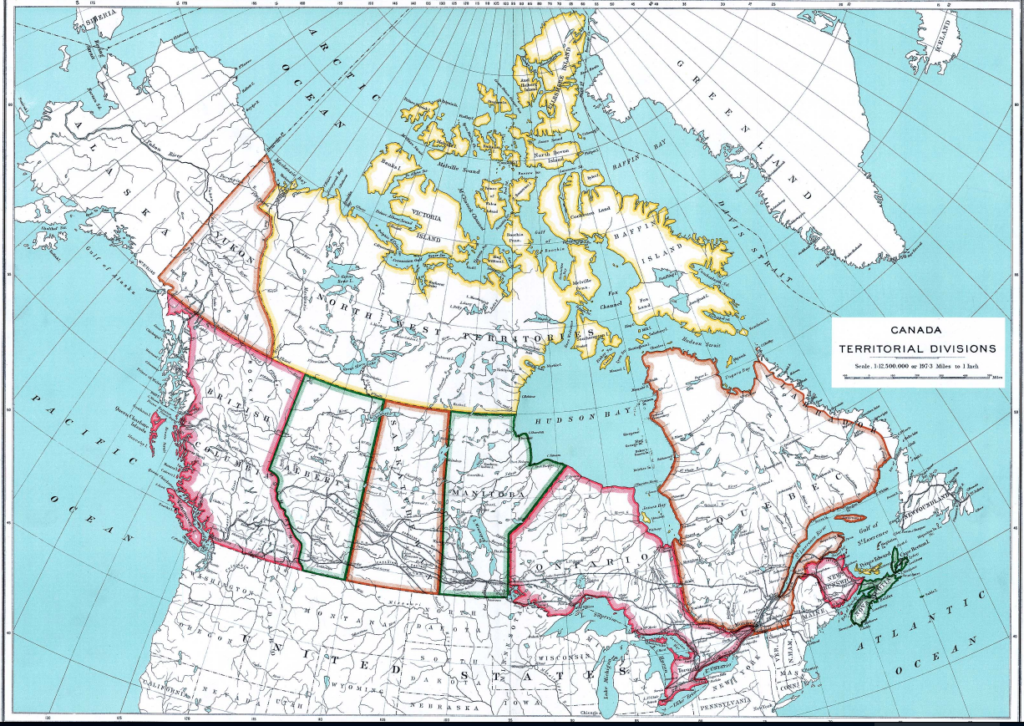
Canada, Department of the Interior, Atlas of Canada, revised and enlarged ed. (1915), map 3-4 “Territorial Divisions”; accessed as https://atlas.gc.ca/PDF/1915_Atlas_E.pdf
I’ve helped many clients find the documents they need to apply for certificates of Canadian citizenship. I can help you, too! Contact me for more information.
Disclaimer: I am a genealogist, not a lawyer. This post does not constitute legal advice or opinion. It contains my personal observations to provide a non-expert interpretation of Canada’s current law regarding citizenship by descent.